Friday, 21 November 2014

Advanced Pharmaceutical Microbiology

Antibiotics
Testing the susceptibility of Staphylococcus aureus to antibiotics by the Kirby-Bauer disk diffusion method – antibiotics diffuse from antibiotic-containing disks and inhibit growth of S. aureus, resulting in a zone of inhibition.
An antibiotic is an agent that either kills or inhibits the growth of a microorganism.
The term antibiotic was first used in 1942 by Selman Waksman and his collaborators in journal articles to describe any substance produced by a microorganism that is antagonistic to the growth of other microorganisms in high dilution. The first antibiotic discovered was called penicillin by Alexander Fleming in 1929. This definition excluded substances that kill bacteria but that are not produced by microorganisms (such as gastric juices and hydrogen peroxide). It also excluded synthetic antibacterial compounds such as the sulfonamides. Many antibacterial compounds are relatively small molecules with a molecular weight of less than 2000 atomic mass units.
With advances in medicinal chemistry, most modern antibacterials are semisynthetic modifications of various natural compounds. These include, for example, the beta-lactam antibiotics, which include the penicillins (produced by fungi in the genus Penicillium), the cephalosporins, and the carbapenems. Compounds that are still isolated from living organisms are the aminoglycosides, whereas other antibacterials—for example, the sulfonamides, the quinolones, and the oxazolidinones—are produced solely by chemical synthesis. In accordance with this, many antibacterial compounds are classified on the basis of chemical/biosynthetic origin into natural, semisynthetic, and synthetic. Another classification system is based on biological activity; in this classification, antibacterials are divided into two broad groups according to their biological effect on microorganisms: Bactericidal agents kill bacteria, and bacteriostatic agents slow down or stall bacterial growth.
History


Penicillin, the first natural antibiotic discovered by Alexander Fleming in 1928
Before the early 20th century, treatments for infections were based primarily on medicinal folklore. Mixtures with antimicrobial properties that were used in treatments of infections were described over 2000 years ago. Many ancient cultures, including the Ayurveda, ancient Egyptians and ancient Greeks, used specially selected mold and plant materials and extracts to treat infections. More recent observations made in the laboratory of antibiosis between microorganisms led to the discovery of natural antibacterials produced by microorganisms. Louis Pasteur observed, "if we could intervene in the antagonism observed between some bacteria, it would offer perhaps the greatest hopes for therapeutics". The term 'antibiosis', meaning "against life", was introduced by the French bacteriologist Jean Paul Vuillemin as a descriptive name of the phenomenon exhibited by these early antibacterial drugs. Antibiosis was first described in 1877 in bacteria when Louis Pasteur and Robert Koch observed that an airborne bacillus could inhibit the growth of Bacillus anthracis. These drugs were later renamed antibiotics by Selman Waksman, an American microbiologist, in 1942. Synthetic antibiotic chemotherapy as a science and development of antibacterials began in Germany with Paul Ehrlich in the late 1880s. Ehrlich noted certain dyes would color human, animal, or bacterial cells, whereas others did not. He then proposed the idea that it might be possible to create chemicals that would act as a selective drug that would bind to and kill bacteria without harming the human host. After screening hundreds of dyes against various organisms, he discovered a medicinally useful drug, the synthetic antibacterial salvarsan now called arsphenamine.
The effects of some types of mold on infection had been noticed many times over the course of history (see: History of penicillin). In 1928, Alexander Fleming noticed the same effect in a Petri dish, where a number of disease-causing bacteria were killed by a fungus of the genus Penicillium. Fleming postulated that the effect is mediated by an antibacterial compound he named penicillin, and that its antibacterial properties could be exploited for chemotherapy. He initially characterized some of its biological properties, and attempted to use a crude preparation to treat some infections, but he was unable to pursue its further development without the aid of trained chemists.
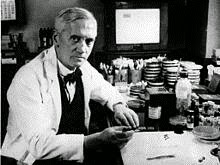


Alexander Fleming
The first sulfonamide and first commercially available antibacterial, Prontosil, was developed by a research team led by Gerhard Domagk in 1932 at the Bayer Laboratories of the IG Farben conglomerate in Germany. Domagk received the 1939 Nobel Prize for Medicine for his efforts. Prontosil had a relatively broad effect against Gram-positive cocci, but not against enterobacteria. Research was stimulated apace by its success. The discovery and development of this sulfonamide drug opened the era of antibacterials.
In 1939, coinciding with the start of World War II, Rene Dubos reported the discovery of the first naturally derived antibiotic, tyrothricin, a compound of 20% gramicidin and 80% tyrocidine, from B. brevis. It was one of the first commercially manufactured antibiotics universally and was very effective in treating wounds and ulcers during World War II. Gramicidin, however, could not be used systemically because of toxicity. Tyrocidine also proved too toxic for systemic usage. Research results obtained during that period were not shared between the Axis and the Allied powers during the war.
Florey and Chain succeeded in purifying the first penicillin, penicillin G, in 1942, but it did not become widely available outside the Allied military before 1945. The chemical structure of penicillin was determined by Dorothy Crowfoot Hodgkin in 1945. Purified penicillin displayed potent antibacterial activity against a wide range of bacteria and had low toxicity in humans. Furthermore, its activity was not inhibited by biological constituents such as pus, unlike the synthetic sulfonamides. The discovery of such a powerful antibiotic was unprecedented, and the development of penicillin led to renewed interest in the search for antibiotic compounds with similar efficacy and safety. For their successful development of penicillin, which Fleming had accidentally discovered but could not develop himself, as a therapeutic drug, Ernst Chain and Howard Florey shared the 1945 Nobel Prize in Medicine with Fleming. Florey credited Dubos with pioneering the approach of deliberately and systematically searching for antibacterial compounds, which had led to the discovery of gramicidin and had revived Florey's research in penicillin.
Etymology
The term "antibiotic" derives from anti + βιωτικός (biōtikos), "fit for life, lively", which comes from βίωσις (biōsis), "way of life", and that from βίος (bios), "life".
The term "antibacterial" derives from Greek ἀντί (anti), "against" + βακτήριον (baktērion), diminutive of βακτηρία (baktēria), "staff, cane", because the first ones to be discovered were rod-shaped.
Medical uses
Treatment
Pharmacodynamics

The successful outcome of antimicrobial therapy with antibacterial compounds depends on several factors. These include host defense mechanisms, the location of infection, and the pharmacokinetic and pharmacodynamic properties of the antibacterial. A bactericidal activity of antibacterials may depend on the bacterial growth phase, and it often requires ongoing metabolic activity and division of bacterial cells. These findings are based on laboratory studies, and in clinical settings have also been shown to eliminate bacterial infection. Since the activity of antibacterials depends frequently on its concentration, in vitro characterization of antibacterial activity commonly includes the determination of the minimum inhibitory concentration and minimum bactericidal concentration of an antibacterial. To predict clinical outcome, the antimicrobial activity of an antibacterial is usually combined with its pharmacokinetic profile, and several pharmacological parameters are used as markers of drug efficacy.
Classes


Molecular targets of antibiotics on the bacteria cell
Antibacterial antibiotics are commonly classified based on their mechanism of action, chemical structure, or spectrum of activity. Most target bacterial functions or growth processes. Those that target the bacterial cell wall (penicillins and cephalosporins) or the cell membrane (polymyxins), or interfere with essential bacterial enzymes (rifamycins, lipiarmycins, quinolones, and sulfonamides) have bactericidal activities. Those that target protein synthesis (macrolides, lincosamides and tetracyclines) are usually bacteriostatic (with the exception of bactericidal aminoglycosides). Further categorization is based on their target specificity. "Narrow-spectrum" antibacterial antibiotics target specific types of bacteria, such as Gram-negative or Gram-positive bacteria, whereas broad-spectrum antibiotics affect a wide range of bacteria. Following a 40-year hiatus in discovering new classes of antibacterial compounds, four new classes of antibacterial antibiotics have been brought into clinical use: cyclic lipopeptides (such as daptomycin), glycylcyclines (such as tigecycline), oxazolidinones (such as linezolid), and lipiarmycins (such as fidaxomicin).
Production
Since the first pioneering efforts of Florey and Chain in 1939, the importance of antibiotics, including antibacterials, to medicine has led to intense research into producing antibacterials at large scales. Following screening of antibacterials against a wide range of bacteria, production of the active compounds is carried out using fermentation, usually in strongly aerobic conditions.
Administration
Oral antibiotics are taken by mouth, whereas intravenous administration may be used in more serious cases, such as deep-seated systemic infections. Antibiotics may also sometimes be administered topically, as with eye drops or ointments.
The topical antibiotics are:
  • Erythromycin
  • Clindamycin
  • Gentamycin
  • Tetracycline
  • Meclocycline
  • (Sodium) sulfacetamide
While topical medications that act as Comedolytics as well as antibiotics are:
  • Benzoyl peroxide
  • Azelaic acid
Side-effects

Antibiotics are screened for any negative effects on humans or other mammals before approval for clinical use, and are usually considered safe and most are well-tolerated. However, some antibiotics have been associated with a range of adverse side effects. Side-effects range from mild to very serious depending on the antibiotics used, the microbial organisms targeted, and the individual patient. Safety profiles of newer drugs are often not as well-established as for those that have a long history of use. Adverse effects range from fever and nausea to major allergic reactions, including photodermatitis and anaphylaxis. Common side-effects include diarrhea, resulting from disruption of the species composition in the intestinal flora, resulting, for example, in overgrowth of pathogenic bacteria, such as Clostridium difficile. Antibacterials can also affect the vaginal flora, and may lead to overgrowth of yeast species of the genus Candida in the vulvo-vaginal area. Additional side-effects can result from interaction with other drugs, such as elevated risk of tendon damage from administration of a quinolone antibiotic with a systemic corticosteroid. Some scientists have hypothesized that the indiscriminate use of antibiotics alter the host microbiota and this has been associated with chronic disease

Thursday, 20 November 2014

Herbs, spices enhance heart health as well as flavour

SPICES and herbs are rich in antioxidants, which may help improve triglyceride concentrations and other blood lipids, according to Penn State nutritionists.
    Triglyceride levels rise after eating a high-fat meal — which can lead to an increased risk of heart disease. If a high-antioxidant spice blend is incorporated into the meal, triglyceride levels may be reduced by as much as 30 percent when compared to eating an identical meal without the spice blend. The spiced meal included garlic powder, rosemary, oregano, cinnamon, cloves, paprika, turmeric, ginger and black pepper.
    Sheila G. West, professor of biobehavioral health and nutritional sciences, and Ann C. Skulas-Ray, research associate in nutritional sciences, reviewed a variety of research papers that focused on the effects that spices and herbs have on cardiovascular disease risk. They published their findings in a supplement to the current issue of the journal Nutrition Today, based on papers presented at the McCormick Science Institute Summit held in May 2014.
    “The metabolic effects of spices and herbs and their efficacy and safety relative to traditional drug therapy represent an exciting area for future research given the public health significance of cardiovascular disease,” the researchers wrote.
    West and Skulas-Ray looked at three categories of studies — spice blends, cinnamon and garlic.
     “We live in a world where people consume too many calories every day,” said West. “Adding high-antioxidant spices might be a way to reduce calories without sacrificing taste.”

    West and Skulas-Ray reviewed several cinnamon studies that looked at the effect of the spice on both diabetics and non-diabetics. Cinnamon was shown to help diabetics by significantly reducing cholesterol and other blood lipids in the study participants. However, cinnamon did not appear to have any effect on non-diabetics.
   The garlic studies reviewed were inconclusive, but this is likely because the trials had a wide range of garlic doses, from nine milligrams of garlic oil to 10 grams of raw garlic. The reviewers noted that across the studies there was an eight percent decrease in total cholesterol with garlic consumption, which was associated with a 38 percent decrease in risk of heart problems in 50-year-old adults.
   In the study West, Skulas-Ray and colleagues conducted, they prepared meals on two separate days for six men between the ages of 30 and 65 who were overweight, but otherwise healthy. The meals were identical — consisting of chicken, bread and a dessert biscuit — except that the researchers added two tablespoons of a high-antioxidant culinary spice blend to the test meal.
     The researchers followed the participants for three hours after each meal, drawing blood every 30 minutes. Antioxidant activity in the blood increased by 13 percent after the men ate the test meal when compared to the control meal, which may help prevent cardiovascular disease and other chronic diseases.
    West and colleagues are currently working on a study to monitor study participants for eight hours after eating a meal with a high-antioxidant spice blend. They want to know what happens to the fat in such a meal.

     “If (the fat) isn’t being absorbed when spices are included in the meal, it might be excreted instead,” said West. “We will examine whether spices affect how rapidly the meal is processed through the stomach and intestines.”

Wednesday, 19 November 2014


ADVANCED Microbial genetics & molecular biology
Heredity

Heredity is the passing of traits to offspring from their parents. This is the process by which an offsprings cell or organisms are acquired or become predisposed to the characteristics of its parent cell or organism. Through heredity, variations exhibited by individuals can accumulate and cause some species to evolve. The study of heredity in biology is called genetics, which includes the field of epigenetics.
Overview
In humans, eye color is an example of an inherited characteristic: an individual might inherit the "brown-eye trait" from one of the parents. Inherited traits are controlled by genes and the complete set of genes within an organism's genome is called its genotype.
The complete set of observable traits of the structure and behavior of an organism is called its phenotype. These traits arise from the interaction of its genotype with the environment. As a result, many aspects of an organism's phenotype are not inherited. For example, suntanned skin comes from the interaction between a person's phenotype and sunlight; thus, suntans are not passed on to people's children. However, some people tan more easily than others, due to differences in their genotype: a striking example is people with the inherited trait of albinism, who do not tan at all and are very sensitive to sunburn.
Heritable traits are known to be passed from one generation to the next via DNA, a molecule that encodes genetic information. DNA is a long polymer that incorporates four types of bases, which are interchangeable. The sequence of bases along a particular DNA molecule specifies the genetic information: this is comparable to a sequence of letters spelling out a passage of text. Before a cell divides through mitosis, the DNA is copied, so that each of the resulting two cells will inherit the DNA sequence. A portion of a DNA molecule that specifies a single functional unit is called a gene; different genes have different sequences of bases. Within cells, the long strands of DNA form condensed structures called chromosomes. Organisms inherit genetic material from their parents in the form of homologous chromosomes, containing a unique combination of DNA sequences that code for genes. The specific location of a DNA sequence within a chromosome is known as a locus. If the DNA sequence at a particular locus varies between individuals, the different forms of this sequence are called alleles. DNA sequences can change through mutations, producing new alleles. If a mutation occurs within a gene, the new allele may affect the trait that the gene controls, altering the phenotype of the organism.
However, while this simple correspondence between an allele and a trait works in some cases, most traits are more complex and are controlled by multiple interacting genes within and among organisms. Developmental biologists suggest that complex interactions in genetic networks and communication among cells can lead to heritable variations that may underlay some of the mechanics in developmental plasticity and canalization.
Recent findings have confirmed important examples of heritable changes that cannot be explained by direct agency of the DNA molecule. These phenomena are classed as epigenetic inheritance systems that are causally or independently evolving over genes. Research into modes and mechanisms of epigenetic inheritance is still in its scientific infancy, however, this area of research has attracted much recent activity as it broadens the scope of heritability and evolutionary biology in general. DNA methylation marking chromatin, self-sustaining metabolic loops, gene silencing by RNA interference, and the three dimensional conformation of proteins (such as prions) are areas where epigenetic inheritance systems have been discovered at the organismic level. Heritability may also occur at even larger scales. For example, ecological inheritance through the process of niche construction is defined by the regular and repeated activities of organisms in their environment. This generates a legacy of effect that modifies and feeds back into the selection regime of subsequent generations. Descendants inherit genes plus environmental characteristics generated by the ecological actions of ancestors. Other examples of heritability in evolution that are not under the direct control of genes include the inheritance of cultural traits, group heritability, and symbiogenesis. These examples of heritability that operate above the gene are covered broadly under the title of multilevel or hierarchical selection, which has been a subject of intense debate in the history of evolutionary science.


Relation to theory of evolution
When Charles Darwin proposed his theory of evolution in 1859, one of its major problems was the lack of an underlying mechanism for heredity. Darwin believed in a mix of blending inheritance and the inheritance of acquired traits (pangenesis). Blending inheritance would lead to uniformity across populations in only a few generations and then would remove variation from a population on which natural selection could act. This led to Darwin adopting some Lamarckian ideas in later editions of On the Origin of Species and his later biological works. Darwin's primary approach to heredity was to outline how it appeared to work (noticing that traits that were not expressed explicitly in the parent at the time of reproduction could be inherited, that certain traits could be sex-linked, etc.) rather than suggesting mechanisms.
Darwin's initial model of heredity was adopted by, and then heavily modified by, his cousin Francis Galton, who laid the framework for the biometric school of heredity. Galton found no evidence to support the aspects of Darwin's pangenesis model, which relied on acquired traits.
The inheritance of acquired traits was shown to have little basis in the 1880s when August Weismann cut the tails off many generations of mice and found that their offspring continued to develop tails.
History
The ancients had a variety of ideas about heredity: Theophrastus proposed that male flowers caused female flowers to ripen; Hippocrates speculated that "seeds" were produced by various body parts and transmitted to offspring at the time of conception; and Aristotle thought that male and female semen mixed at conception. Aeschylus, in 458 BC, proposed the male as the parent, with the female as a "nurse for the young life sown within her".
Various hereditary mechanisms were envisaged without being properly tested or quantified. These included blending inheritance and the inheritance of acquired traits. Nevertheless, people were able to develop domestic breeds of animals as well as crops through artificial selection. The inheritance of acquired traits also formed a part of early Lamarckian ideas on evolution.
During the 18th century, Dutch microscopist Antonie van Leeuwenhoek (1632–1723) discovered "animalcules" in the sperm of humans and other animals. Some scientists speculated they saw a "little man" (homunculus) inside each sperm. These scientists formed a school of thought known as the "spermists". They contended the only contributions of the female to the next generation were the womb in which the homunculus grew, and prenatal influences of the womb. An opposing school of thought, the ovists, believed that the future human was in the egg, and that sperm merely stimulated the growth of the egg. Ovists thought women carried eggs containing boy and girl children, and that the gender of the offspring was determined well before conception.
Gregor Mendel: father of genetics
The idea of particulate inheritance of genes can be attributed to the Moravian monk Gregor Mendel who published his work on pea plants in 1865. However, his work was not widely known and was rediscovered in 1901. It was initially assumed the Mendelian inheritance only accounted for large (qualitative) differences, such as those seen by Mendel in his pea plants—and the idea of additive effect of (quantitative) genes was not realised until R. A. Fisher's (1918) paper, "The Correlation Between Relatives on the Supposition of Mendelian Inheritance" Mendel's overall contribution gave scientists a useful overview that traits were inheritable. As of today, his pea plant demonstration became the foundation of the study of Mendelian Traits. These traits can be traced on a single locus.
Modern development of genetics and heredity
In the 1930s, work by Fisher and others resulted in a combination of Mendelian and biometric schools into the modern evolutionary synthesis. The modern synthesis bridged the gap between experimental geneticists and naturalists; and between both and palaeontologists, stating that:
  1. All evolutionary phenomena can be explained in a way consistent with known genetic mechanisms and the observational evidence of naturalists.
  2. Evolution is gradual: small genetic changes, recombination ordered by natural selection. Discontinuities amongst species (or other taxa) are explained as originating gradually through geographical separation and extinction (not saltation).
  3. Selection is overwhelmingly the main mechanism of change; even slight advantages are important when continued. The object of selection is the phenotype in its surrounding environment. The role of genetic drift is equivocal; though strongly supported initially by Dobzhansky, it was downgraded later as results from ecological genetics were obtained.
  4. The primacy of population thinking: the genetic diversity carried in natural populations is a key factor in evolution. The strength of natural selection in the wild was greater than expected; the effect of ecological factors such as niche occupation and the significance of barriers to gene flow are all important.
  5. In palaeontology, the ability to explain historical observations by extrapolation from micro to macro-evolution is proposed. Historical contingency means explanations at different levels may exist. Gradualism does not mean constant rate of change.
The idea that speciation occurs after populations are reproductively isolated has been much debated. In plants, polyploidy must be included in any view of speciation. Formulations such as 'evolution consists primarily of changes in the frequencies of alleles between one generation and another' were proposed rather later. The traditional view is that developmental biology ('evo-devo') played little part in the synthesis, but an account of Gavin de Beer's work by Stephen Jay Gould suggests he may be an exception.
Almost all aspects of the synthesis have been challenged at times, with varying degrees of success. There is no doubt, however, that the synthesis was a great landmark in evolutionary biology. It cleared up many confusions, and was directly responsible for stimulating a great deal of research in the post-World War II era.
Trofim Lysenko however caused a backlash of what is now called Lysenkoism in the Soviet Union when he emphasised Lamarckian ideas on the inheritance of acquired traits. This movement affected agricultural research and led to food shortages in the 1960s and seriously affected the USSR.
Common genetic disorders
·         Down syndrome
·         Huntington's disease
·         Phenylketonuria (PKU)
·         Haemophilia
Types of heredity
Dominant and recessive alleles
An allele is said to be dominant if it is always expressed in the appearance of an organism (phenotype) provided that at least one copy of it is present. For example, in peas the allele for green pods, G, is dominant to that for yellow pods, g. Thus pea plants with the pair of alleles either GG (homozygote) or Gg (heterozygote) will have green pods. The allele for yellow pods is recessive. The effects of this allele are only seen when it is present in both chromosomes, gg (homozygote).
The description of a mode of biological inheritance consists of three main categories:
1. Number of involved loci
·         Monogenetic (also called "simple") – one locus
·         Oligogenetic – few loci
·         Polygenetic – many loci
2. Involved chromosomes
·         Autosomal – loci are not situated on a sex chromosome
·         Gonosomal – loci are situated on a sex chromosome
o    X-chromosomal – loci are situated on the X-chromosome (the more common case)
o    Y-chromosomal – loci are situated on the Y-chromosome
·         Mitochondrial – loci are situated on the mitochondrial DNA
3. Correlation genotypephenotype
·         Dominant
·         Intermediate (also called "codominant")
·         Recessive
·         Overdominant
·         Underdominant
These three categories are part of every exact description of a mode of inheritance in the above order. In addition, more specifications may be added as follows:
4. Coincidental and environmental interactions
·         Penetrance
o    Complete
o    Incomplete (percentual number)
·         Expressivity
o    Invariable
o    Variable
·         Heritability (in polygenetic and sometimes also in oligogenetic modes of inheritance)
·         Maternal or paternal imprinting phenomena (also see epigenetics)
5. Sex-linked interactions
·         Sex-linked inheritance (gonosomal loci)
·         Sex-limited phenotype expression (e.g., cryptorchism)
·         Inheritance through the maternal line (in case of mitochondrial DNA loci)
·         Inheritance through the paternal line (in case of Y-chromosomal loci)
6. Locus–locus interactions
·         Epistasis with other loci (e.g., overdominance)
·         Gene coupling with other loci (also see crossing over)
·         Homozygotous lethal factors
·         Semi-lethal factors

Determination and description of a mode of inheritance is achieved primarily through statistical analysis of pedigree data. In case the involved loci are known, methods of molecular genetics can also be employed.